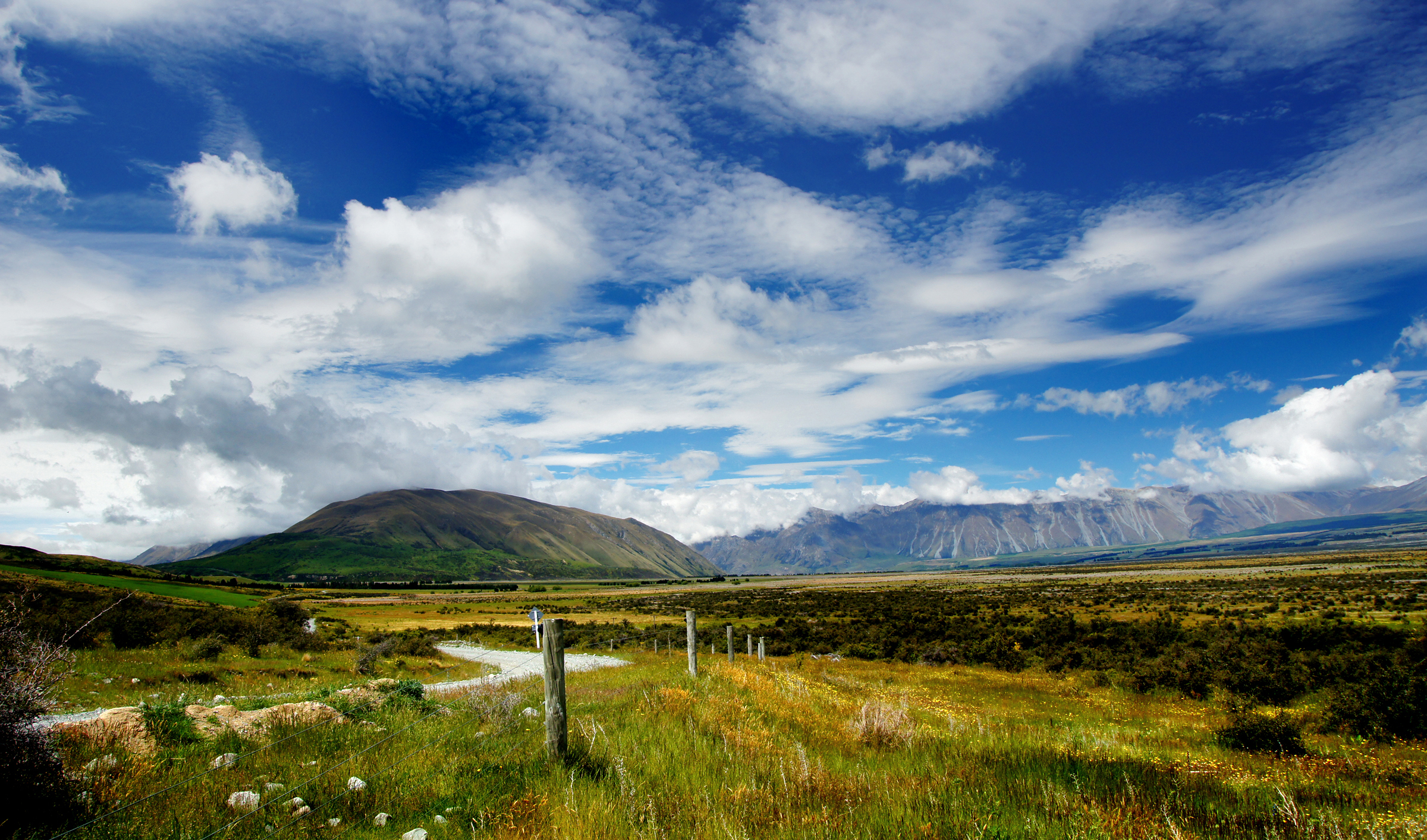
Canterbury back country near Lord of the Rings filming locations. Photo by Bernard Spragg, CC0 via Wikimedia Commons.
The more you think about The Lord of the Rings, the less it behaves like a clean fantasy adventure.
Why are the kingdoms so badly organized? Why is everyone living in ruins built by people who were better at nearly everything? Why can nobody simply use the powerful thing correctly? Why do the Elves pack up and leave immediately after the good guys win?
Because Middle-earth is not a healthy world interrupted by Sauron.
Middle-earth was already dying.
Sauron is the emergency. Decline is the setting.
The World Is Running on Inherited Infrastructure
Gondor is defending cities built by people more powerful than anyone currently alive. Arnor is gone. Númenor is under the ocean. The great roads are broken. Towers built to watch for evil are abandoned, corrupted, or occupied by whichever lunatic arrives first.
Everyone is living inside the remains of a civilization they cannot replace. The map feels empty because it is full of dead kingdoms, haunted places, and land nobody controls anymore.
The Fellowship is not crossing a thriving continent. It is walking through the archaeological evidence of repeated failure.
And the Men of Middle-earth inherit all of it.
Mortality Is the Whole Point
Elves have millennia. Wizards are ancient spirits. Dwarves are spiteful little tanks. Men get about eighty years, a family curse, a crumbling kingdom, and a sword found in several pieces.
Then Tolkien asks them to hold the line against a literal fallen angel.
Tolkien calls death the Gift of Men, which sounds like the sort of gift you return without opening. Elves remain bound to the world. Men leave it, and even the Elves do not know exactly where they go.
Every human choice in Tolkien is made under a clock. Aragorn, Théoden, Boromir, and Éowyn do not have forever to repair what has already been broken.
Their courage matters because their time costs more.
Aragorn Earns the Crown Before He Wears It
Aragorn is eighty-seven during the War of the Ring. Before anybody hands him a crown, he spends decades protecting people who do not know his name. He serves in the armies of Rohan and Gondor under another identity. He hunts Gollum. He patrols the North. He learns healing, languages, history, and the exhausting art of dealing with Hobbits who wander directly toward danger while asking about lunch.
He does not become king because a sword glows and a soundtrack swells. He becomes king because he has already been doing the job without the title.
At the Black Gate, he knowingly volunteers to become a distraction. Not a conqueror. Not a chosen king sweeping in to win the war.
Bait.
Merlin's saggy nuts, that is a man.
Boromir Fails for a Reason That Makes Terrible Sense
Boromir is not weak. Boromir is desperate.
The Ring tempts him with the ability to save Gondor. It takes his best quality, devotion, and twists it until he cannot tell sacrifice from possession.
That is what the Ring does. It does not offer random evil. It offers the power to impose your will for reasons that feel righteous. Gandalf would use it to force the world toward wisdom. Galadriel would become a beautiful and terrifying queen. Boromir would save Gondor by turning it into something Gondor was never meant to be.
There is no correct user. There is only slower corruption.
Boromir falls. Then he understands what he has done, admits it, and dies protecting Merry and Pippin.
Tolkien lets the failure remain real and the redemption remain real too. That is human heroism, not purity, but what you do after you finally see yourself clearly.
Théoden Stands Up Inside the Wreckage
Théoden does not begin as a shining warrior king. His body is failing. His son is dead. His judgment has been manipulated. His people have watched him become a ghost in his own hall.
When he is restored, Tolkien does not give him his youth back. He does not undo the years he lost. Théoden has to stand up inside the wreckage of his own life.
He answers Gondor's call and reaches the Pelennor Fields knowing exactly what waits for him. He leads the charge anyway.
His victory is not survival. His victory is becoming himself again before he dies.
Éowyn Gets the Harder Ending
Éowyn is brave, angry, trapped, and dangerously close to confusing death with freedom. She rides because the life available to her feels like a slower death.
She steps between death and someone she loves, faces the Witch-king, and exploits a prophecy with the kind of grammatical loophole that would make a Ravenclaw weep with joy.
Merry's ancient blade breaks the spell binding the Witch-king. Éowyn delivers the killing strike. A Hobbit carrying a weapon from a fallen kingdom and a woman refusing the role assigned to her work together across centuries.
Then Tolkien gives Éowyn something harder than a heroic death.
He makes her live.
Her final victory is choosing a future after she had stopped believing one existed.
Frodo Fails, and the Quest Still Succeeds
This is the part people sand down because it makes them uncomfortable.
Frodo does not stand inside Mount Doom and heroically throw the Ring away. At the final moment, he claims it.
The world is saved because Bilbo and Frodo previously spared Gollum. Their mercy creates an outcome neither could control.
Frodo gets farther than almost anyone could have, then breaks exactly where anyone would break. Providence finishes what courage began.
That is messier than a heroic triumph. It is also the moral architecture of the entire story.
Victory Is Managed Decline
The Ring is destroyed. Sauron falls. Aragorn is crowned.
And magic still leaves the world.
The Elves depart. The great Rings lose their power. Rivendell and Lothlórien can no longer be preserved outside time. Frodo cannot stay. The Shire can be repaired, but he cannot.
The heroes do not save Middle-earth from change. They save enough of it to have a future inside the change.
Tolkien is not promising that courage stops loss. He is arguing that courage decides what survives the loss.
The mortal heroes know they will die. They know their kingdoms will eventually fade. They know every victory is temporary.
They stand anyway.
Not because they are sure they will win.
Because somebody has to.

No comments:
Post a Comment