• Explore a Mediterranean island paradise with complete vertical freedom – skydive, BASE jump and free dive in an open world with virtually zero limits • Glide through the air and swoop across mountains with your Wingsuit giving a new way to rain death from above • Use your Grapple and Parachute to scale buildings, hijack vehicles, move quickly or tether objects together for creative new ways to cause Chaos. • Cause massive chains of destruction in military bases, harbours, prisons, police stations and communications facilities to bring down a dictator • Arm yourself with a wide range of explosive weaponry from shotguns and missile launchers to tank-busters and air-strikes • Choose from a huge variety of different vehicles to drive including speedboats, jets, helicopters, turbo-fuelled sports cars and superbikes • Get adventurous with dozens of challenge missions and collectibles to discover
There are things that I wish were different about Just Cause 3. I wish there was a sprint button. I wish the aiming wasn’t such dirt. I wish that the writing and mission design weren’t so inconsistent, weird, and just plain bad. I wish that it gave you more ammo for rocket launchers, sooner. I wish the load times weren’t so excruciating. I wish that the game didn’t slow down so much when the screen fills with explosions. I really wish that it didn't slow me to being incapacitated when I'm hurt. I'd rather just die and respawn already.
But that’s about it.
So... the explosions are amazing. If you're suppressing an inner destructive beast I highly recommend unleashing them on this game. The story line isn't the best I've ever experienced, but it's certainly good enough to keep me involved in the game on a level beyond just wreaking havoc. It's got a great soundtrack. The multiplayer competition piece is actually really cool. I love seeing myself slide up the rankings when I get a new "personal best" on any task.
In an industry lousy with open world games, Just Cause 3 may be the only recent release that truly qualifies as a sandbox. You are Rico Rodriguez, the mildly charming, near-invincible protagonist with a nice pair of boots that I’ve been trying to replicate in reality. You’ve returned to your fictional home of Medici, a Mediterranean archipelago held captive under a brutal dictator’s thumb. After a short intro mission that starts with you firing RPGs standing on top of a biplane, you’re free to wander. And that’s what you’ll want to do.
LET ME GIVE YOU GUYS SOME LIBERATION!!! I AM LIBERATING YOU!! (As I blow the entire city up and shoot innocents in my crossfire)
The game’s heart lies in its pitch-perfect realization of screwing around, loosely organized around liberating Medici. If you go looking for more structure than that, you’ll hopefully wind up playing a different game. You spend your time, throwing grenades and watching the insane domino of massive explosions, calmly parachuting around a picturesque village firing rockets at loudspeakers, tethering weird things together and watching what happens, wing suiting through caverns and grappling into helicopters. You spend your time doing whatever it is you feel like.
So in summation, while others might not love the game, myself and my husband both enjoy it a lot.
4.2/5
Tuesday, June 28, 2016

Paul Stanton Running For Florida State Senate

Bio from Stanton’s Facebook page:
Paul Stanton is honored to run as a candidate to represent the State of Florida in the U.S. Senate. A world-traveled individual, Paul has been living in Florida after serving in the U.S. Army and roaming the continental U.S. as an information technology specialist. After six years of service and a tour of duty in Iraq, Paul received his honorable discharge from the U.S. Army and immediately adopted a philosophy of responsible service to community. He was the founding member of the Indiana University-Purdue University Fort Wayne Students Against War organization and led protests against violence and interventionism in Iraq and Afghanistan. At one point he even sued the airport for the right to protest the use of overly-invasive body scanners in airports. As your Senator, he will fight for the rights of everyday citizens to preserve the freedoms that are quickly being eroded by corrupt partisan politics.

Paul is committed to an agenda based on the principles of individual freedom and a common sense-approach to taxes. As Senator, he promises to advance a platform of non-aggression, seeking to end the United States involvements in the Middle East and mitigating the harm we have already caused. Additionally, he advocates for an end to the “War on Drugs” and incarceration of users, and instead advocates for treatment and education for those who are addicted. Paul will also demand an overhaul of the federal tax system, where even those who are poor are still overburdened with taxes on the fruits of their labors through a “War on the Poor.” A resident of Deland, Florida, Paul lives
surrounded by family, friends, and neighbors who are proud to call him one of their own.
According to his Twitter, @StantonForLiberty, his stance can be simplified into "Anti-violence, anti-coercion, anti-fraud". So what does this mean, and where does he stand on the issues?
On Business Taxation:
Businesses leave the United States for a multitude of reasons, one of which, is corporate taxation. While corporate taxation can contribute to stifling business and job growth, this is especially true for small businesses. Large corporations are actually in a much better position to handle taxation because of their ability to pay it and/or move operations offshore as to avoid the taxation. Small businesses that are incorporated and looking to grow are not awarded those same privileges.
The first step to fostering competition is producing a more free market with lower government intrusion and taxation for small businesses. If elected, I will propose to cut taxes for companies with less than $500,000 in revenue completely, and work to reduce taxation for all businesses as much as possible. This reduction for small businesses is a positive first step, as small businesses will be able to take that saved money and invest it in growing their business and expanding the economy.
In addition to lowering tax rates for small businesses as a first step to reducing taxation for businesses across the board, I will work to eliminate the taxation on repatriated profits from overseas. There is over $2.1 trillion dollars sitting overseas that should be in the United States if it were not due to our tax policies. I will work to bring those dollars back here so they can be invested and help grow the economy.
On Drug Reform:
The “War On Drugs,” has become a device through which those in power have taken our liberties from us, and provide only fear and oppression in return. By bringing this war to an end, we will be able to remove the roadblocks that prevent addicts from getting help, and end the pattern of selectively-enforced felony convictions created by the “War on Drugs” that oppress minorities, the poor, and those not well connected, and that encourage drug users to retreat in fear from their families, their aspirations.To this end, I support the immediate decriminalization of all drugs, the end of mandatory-minimum sentencing for drug-related offenses, and the end of policies that mandate costly and ineffective drug testing for recipients of welfare and other forms of government aid. I also support reducing tax burdens for private rehabilitation programs in order to make them affordable for more people, and to protect the privacy of those suffering from drug addiction. Additionally, I support returning the right to vote nation-wide to those convicted of nonviolent drug-related offenses.
On Poverty Alleviation:
While many politicians pay lip service to helping the poor and disadvantaged, the policies they have put in place actually look more like a war on the poor than a war on poverty. Creating opportunities for all Americans, especially the most marginalized in society, must be a priority. Instead, the focus of policymakers has been on creating a system by which the rich are able to socialize their losses across society at the expense of the poor and working class. We must have a strong economy that provides opportunities for Americans from every walk of life, not just the corporate elite.The first step that should be taken is to eliminate FICA taxes for all workers under the poverty line. While this will certainly help the individual worker, this will also help employers and encourage job growth. The disenfranchised in society also rely heavily on government services that often produce more waste than results. Direct charitable help to the poor should be encouraged, and this can be done by instituting a dollar for dollar tax rebate for charitable donations. This will help eliminate a lot of the waste that is incurred by federal programs designed to provide services to the poor, while also encouraging individuals to be more charitable.
In order to create opportunities to tackle poverty, we must foster the environment that allows small businesses to thrive. I will work to cut down the bureaucracy instituted by many federal agencies that price small businesses out of the market. The federal government stifles jobs by forcing regulations crafted by the corporate elite that help large corporations push small businesses out of competition. So while politicians will try and sell every regulation as protection of the individual, often times they protect monopoly like conditions for big corporations. In addition, while lowering taxes for all businesses should also be a priority, we need to start with eliminating the corporate tax for small businesses so they can invest in their businesses and their communities. In addition, eliminating taxation on repatriated profits from overseas could potentially bring over $2.1 trillion sitting overseas back to the United States.
One of the largest problems facing all Americans is the symbiotic relationship between the federal government and big business. Crony policies, such as corporate bailouts, contribute to massive inequality within our country. In addition to bailouts, subsidies pick winners and losers in the economy, distorting the market. In the case of energy subsidies, they can even have an effect on the environment. I will work to reform crony policies, that again, only go to serving the small minority of corporate elite at the cost of the working class and working poor. We must build a truly free market system in which businesses succeed and fail on their own accord, not by government favors and contributions.
The current policies set in place do more harm than good exacerbating inequality and choking off innovation and growth. We must work to make these changes to truly lift people out of poverty by providing the conditions necessary for a successful economy to thrive. A truly free market with less government intervention in the marketplace and less pressure on the poor can produce not only a stronger economy, but a more equitable society. We can certainly not guarantee equality of result through government intervention, but we must work to provide equality of power to all individuals to empower those currently marginalized to produce a better life for themselves and their families.
On Ending Crony Capitalism:
The market is not what is wrong with the United States economy, but the perversion of the market in favor of a government owned by big business in a symbiotic relationship between the two. Large corporations lobby government and contribute large sums of money to campaigns in order to have their bills passed through congress. Many regulations are made not to protect the consumer, but to protect big business from competition. Competition is what makes the market work, and without it, monopolistic conditions rise that distort the market and further inequality. We should not fight against calls for equality because many of the solutions presented by the current duopoly involve the state, but we should recognize that inequality and, in many cases, poverty are caused by crony policies that seek to give an advantage to one business over another.One large aspect of cronyism was on full display for the economic crash in 2009. The Federal Government took unprecedented measures to bail out large financial firms that were seen as too big to fail. The result was years of mal-investment in the real estate sector subsidized by the Federal Reserve’s low interest rate policies was not allowed to be properly liquidated in the marketplace and the risk taken on by these firms was rewarded. This is a major diversion from the free market. I am in favor of free market policies that allow businesses to grow and thrive, as well as fail when they take on too much risk or function ineffectively. The federal government should not be in the business of propping up failed firms in the economy.
His Monetary Policy:
There is a long history within the United States of strong opposition to the establishment of a national bank, and that battle lives on today. The Federal Reserve has devalued our currency through quantitative easing and low interest rate policies, erasing the savings of many hardworking Americans. Loose monetary policy has been an aid to a growing federal government, using the funds for wars and bailouts. I advocate a complete and full audit of the Federal Reserve as a first step to bring transparency to an organization that largely operates in the shadows. We must challenge the notion that artificial bubbles created by easy money policies will be solved by more easy money policies when the bubbles finally burst.
Interest rates are meant to be set in the marketplace, and currency is meant to hold intrinsic value. Today, our currency is backed by nothing more than the promise of the federal government there is value. I will work to deregulate the monetary system as to allow multiple currencies to compete with each other. This system will greatly reflect the market for credit cards, with different banks offering different banknotes. Ultimately, competition will foster the stronger currencies to trump the weaker currencies. The marketplace should determine the value of the currency and that cannot be done as long as the Federal Reserve maintains a monopoly on our monetary system.
As such, we must recognize the rise of bitcoin and other digital currencies and reject calls for government oversight and regulation. If we believe in the free market of goods and services that helped grow the United States into one of the largest industrial nations in the world, we must recognize that the free market in interest rates and currency must be reestablished.
On Peace:
As an Iraq War combat veteran, I have seen that our military ventures overseas have not brought us greater liberty or safety. Instead, they have bred resentment and hatred of our policy overseas, and have provided a convenient pretext for those in power to chip away at our civil liberties.
In an ever changing world politically, socially, economically, and technologically our current policy of military interventionism is a costly and dangerous heavy hand to use to confront real and potential threats to American safety. Not only is it costly in dollar value, with military spending comprising over half of the federal discretionary spending budget, but it is also costly in political capital. Frequently our nation has been criticized for imperialism at home and abroad. Too often Congress has been able to use the threat of terrorism as an excuse to erode liberty by suspending constitutional rights. I think we, as a nation, are weary of costly, prolonged, and fruitless military campaigns overseas.
Our foreign policy is also costly in human lives, and the goodwill of those we claim to be trying to help. During my tour in Iraq, my friend and fellow soldier shared an epiphany he had that one cannot win the hearts and minds of anyone, friends or foes, while pointing a gun at them. Rather it closes the minds of those who may have once welcomed the idea of American aid and fosters the distrust, fear, and anger that terrorism and other violent ideologies thrive on. This negative sentiment abroad is pushed further with our growing policy of using drones to “selectively target” suspected enemies. News and social media has been flooded with reports of military drones killing and maiming thousands of civilians in Iraq, Pakistan, Yemen, and elsewhere. These are people that often had no connection to terrorism. Violence begets violence. This is not conducive to creating a more stable, peaceful world wherein everyone can have a greater opportunity to prosper.
I stand behind promoting foreign policy that focuses on compassion and understanding. The reality of threats to the security of American citizens should not be justification for the wanton use of military intervention or the erosion of our civil liberty. I support and will work towards the reduction of our military presence overseas in an effort to promote diplomatic solutions and encourage the return to a positive view of America, globally and domestically. I will strive to end our reckless use of drones overseas that have tragically killed so many innocent people (including the Denver-born American child, Abdulrahman Anwar al-Awlaki) in the name of fighting terrorism. And I will endeavor to rebuild the bulwark protecting our freedom that has been torn down by claims of national security.
On Social Security:
The United States government made a promise to workers to provide social security benefits in retirement, and that promise must be kept for retirees and those that have significantly paid into the system. The government’s promise has essentially made many retirees dependent on the current system, and we cannot break those promises to retirees. We must work to make the social security system solvent again, though, instead of using appropriated funds for general government spending. In addition, we must explore different options for young workers that may be a more efficient system.
One aspect of social security that needs to be addressed is the double taxation of social security benefits. Social security contributions are taxed and then payments to retirees are taxed again. This system of taxation makes no sense and reduces benefits to seniors who we have already committed to. Even more than that, though, this taxation of social security benefits allows the Federal Government to appropriate social security money to other parts of the government. I will work hard to end this system of double taxation.
Endorsements:
Paul Stanton has received the following endorsements:
People
Gary Johnson - Libertarian presidential nominee, former Governor of New Mexico
Bill Weld - Libertarian vice presidential nominee, former Governor of Massachusetts
Jim Gray - Jurist, author, former judge, former libertarian vice presidential nominee
John McAfee - Cybersecurity legend, businessman, inventor, former presidential candidate
Darryl W Perry - Activist, author, radio host, lobbyist, former presidential candidate
Dr. Marc Allan Feldmen (deceased) - Physician, former presidential candidate, former candidate for Ohio Treasurer
Kevin McCormick - Former presidential candidate
Will Coley - Activist, radio host, political adviser, former vice presidential candidate
Charles Peralo - Inventor, activist
Libertarian Party Affiliates
Libertarian Party of Collier County, Florida
Organizations
Eastern Liberty Alliance PAC
Monday, June 27, 2016
Where the House Stands on the Presumptive Nominees
The Top Ranking Republicans on Trump
Paul Ryan "isn't ready" to endorse Donald Trump. When asked why not just endorse Trump now, Ryan said he wanted to have a "sincere deliberative process" to discuss common GOP principles.Kevin McCarthy has become a delegate for Donald Trump.
Steve Scalise is endorsing Trump.
Cathy McMorris Rodgers, the top female House Representative, is endorsing Trump.
Luke Messer has spoken against Trump repeatedly, calling him racist and childish.
The Top Ranking Democrats on Hillary
Nancy Pelosi claims the timing "isn't right" for endorsing Hillary.
Steny Hoyer has endorsed Hillary as the "tougher foe" against the GOP.
James Clyborn is endorsing Hillary.
Xavier Becerra heavily endorsed Hillary and was at one point rumored to be vetted as her VP.
Based on the public opinions of the top-ranking members of the House, it looks as though the parties are split on their stance on the presumptive nominees. For Gary Johnson, and any other third party nominee, this is good news. It presents the opportunity for a 3rd party candidate to be elected by the House if neither bi-partisan candidate can win the popular vote.

Based on the public opinions of the top-ranking members of the House, it looks as though the parties are split on their stance on the presumptive nominees. For Gary Johnson, and any other third party nominee, this is good news. It presents the opportunity for a 3rd party candidate to be elected by the House if neither bi-partisan candidate can win the popular vote.

Gary Johnson Could Officially be on the Ballot in All 50 States
News is coming in from across the country reporting Gary on the ballot officially. Vermont and Illinois are among those verifying his slot. Johnson himself has come forward to state he will be on the ballot in all 50 states.

So what does this mean for those of us backing the LP ticket this year? It's been said in the past that if Gary can win his home state of New Mexico that he has a chance at the presidency. Emerging polls indicate that Johnson could not only win electoral votes (something that independent candidate Ross Perot never achieved, despite winning nearly 19% of the popular vote in 1992), but could also—in admittedly extraordinary, but nonetheless possible, circumstances—win the presidency itself.
Some may scoff at this idea since even 12% in the latest Fox News poll seems a long way from victory, and it is. But naysayers are forgetting that Johnson’s target isn’t 50% plus one, as is the case in most two-way races. Trump and Clinton are polling in the 20’s and 30’s when respondents are specifically offered Johnson as an alternative, meaning he could win a state with as little as 34% of the vote, or thereabouts.
Johnson is polling especially well in Utah, one of the few states to show us more localized results. The 1,519 registered voters were first asked about Trump and Clinton, as well as a generic “other” option. 36% chose Trump, 29% Clinton, and 35% other. That alone is promising; considering the 2.5% margin of error, “other” could win Utah. But when respondents were offered Gary Johnson in addition to “other,” support for Trump and Clinton dropped to 29% and 26%, respectively, 16% chose Johnson, and 29% other, for a total of 45% who claim they’d vote for someone other than Trump or Clinton today. Even assuming that some will grudgingly vote for them when push comes to shove, these are the kind of numbers that could precede a third-party victory, particularly considering the possibility that Mitt Romney might endorse Johnson.
If Utah’s six electoral votes go to Gary, that alone could deprive both Trump and Clinton of the 270 required to win outright, though, of course, that would depend on the outcome in swing states. If he managed to win a couple of other states—even states with few electoral votes, like New Mexico (his home state) and Nevada—a House election would be much more likely.
In which case, the vote would go to the House. You might jump to the conclusion that the conservative/republican House would vote Donald Trump, the presumptive nominee of the Republican Party. However, considering how many Republican insiders already want to dump Trump, as well as the certainty that he will continue to anger and embarrass them between now and November, it’s entirely possible that a two-term Republican governor will be their first choice by then. Factor in the possibility of Clinton being indicted or rocked by some new scandal, and the notion that a majority could back Johnson doesn’t seem as ridiculous as it might have had he faced different opponents.
So, if Johnson/Weld hasn't been announced as "officially" on the ballot in your state, keep fighting, you can turn the tide. He may be the "underdog" but he's no fringe candidate.
Let's get him in the debates and on the ballot.
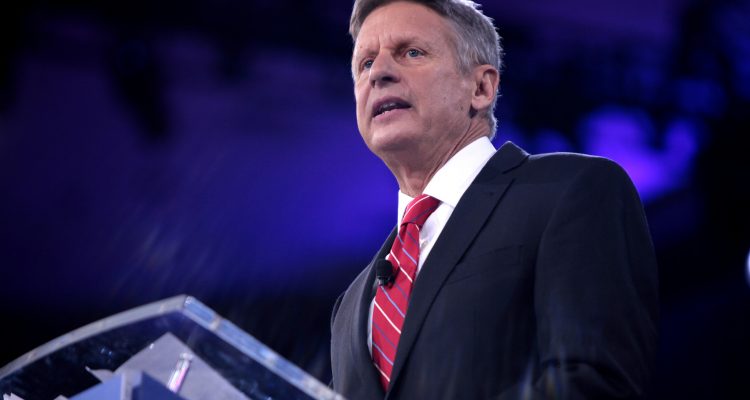
So what does this mean for those of us backing the LP ticket this year? It's been said in the past that if Gary can win his home state of New Mexico that he has a chance at the presidency. Emerging polls indicate that Johnson could not only win electoral votes (something that independent candidate Ross Perot never achieved, despite winning nearly 19% of the popular vote in 1992), but could also—in admittedly extraordinary, but nonetheless possible, circumstances—win the presidency itself.
Some may scoff at this idea since even 12% in the latest Fox News poll seems a long way from victory, and it is. But naysayers are forgetting that Johnson’s target isn’t 50% plus one, as is the case in most two-way races. Trump and Clinton are polling in the 20’s and 30’s when respondents are specifically offered Johnson as an alternative, meaning he could win a state with as little as 34% of the vote, or thereabouts.
Johnson is polling especially well in Utah, one of the few states to show us more localized results. The 1,519 registered voters were first asked about Trump and Clinton, as well as a generic “other” option. 36% chose Trump, 29% Clinton, and 35% other. That alone is promising; considering the 2.5% margin of error, “other” could win Utah. But when respondents were offered Gary Johnson in addition to “other,” support for Trump and Clinton dropped to 29% and 26%, respectively, 16% chose Johnson, and 29% other, for a total of 45% who claim they’d vote for someone other than Trump or Clinton today. Even assuming that some will grudgingly vote for them when push comes to shove, these are the kind of numbers that could precede a third-party victory, particularly considering the possibility that Mitt Romney might endorse Johnson.
If Utah’s six electoral votes go to Gary, that alone could deprive both Trump and Clinton of the 270 required to win outright, though, of course, that would depend on the outcome in swing states. If he managed to win a couple of other states—even states with few electoral votes, like New Mexico (his home state) and Nevada—a House election would be much more likely.
In which case, the vote would go to the House. You might jump to the conclusion that the conservative/republican House would vote Donald Trump, the presumptive nominee of the Republican Party. However, considering how many Republican insiders already want to dump Trump, as well as the certainty that he will continue to anger and embarrass them between now and November, it’s entirely possible that a two-term Republican governor will be their first choice by then. Factor in the possibility of Clinton being indicted or rocked by some new scandal, and the notion that a majority could back Johnson doesn’t seem as ridiculous as it might have had he faced different opponents.
So, if Johnson/Weld hasn't been announced as "officially" on the ballot in your state, keep fighting, you can turn the tide. He may be the "underdog" but he's no fringe candidate.
Let's get him in the debates and on the ballot.
Friday, June 24, 2016
Marc Feldman [56] Libertarian Presidential Nominee Passed Away
Feldman, 56, was found dead yesterday in a Brook Park motel, reported The Plain Dealer. Causes of death are currently unknown. Libertarian National Committee Chair Nicholas Sarwark spread the sad news on Facebook:
The world is a darker place this morning. We have lost one of the lights of the Libertarian Party, Dr. Marc Allan Feldman. My deepest condolences go out to his family on their loss.As many of you may know Feldman was the 5th place Libertarian Finisher. He was born in Washington, DC. He graduated from Northwestern University in 1980 with a degree in Philosophy, before moving on to complete medical training at the prestigious Johns Hopkins School of Medicine. He earned his Master's degree in Health Finance and Management from the Johns Hopkins School of Public Health, and practiced anesthesiology there for 11 years. He is a lifetime member of the Delta Omega public health honor society.
I had the privilege of working with Dr. Feldman on the Libertarian National Committee. After growing up in Washington, D.C., cynical about politics and politicians, he spent most of his adult life not even voting.
In the Libertarian Party, he found a politics of empowering people to be their best selves, free from the control of governments and bureaucrats. It spoke to him in a way that awakened something. He was tireless and dedicated to sharing that vision with everyone he met, but most importantly, with those who didn't participate, didn't vote, and didn't have a voice.
He ran his campaign on the concept of "Votes not for sale" and despite being a diminutive wiseacre his last words at the Orlando Libertarian Convention were of Unity:
Rest in Peace Marc Allan Feldman. You will be missed by many
Thursday, June 23, 2016
The Libertarian Town Hall Key Points and Takeaways
Despite a few knocks from Weld, they stuck to the issues and didn't stoop to name calling and personal attacks.
Johnson abstained when given the chance to personally knock Trump and Clinton."I don't think either of us is going to engage in any sort of name-calling," Johnson said. "We're going to keep this to the issues, and the issues are plenty." (Indeed, Johnson was critical of Trump's immigration plan and other issues.)
Not so much for Weld, who called Trump a "huckster" and repeated a comparison he had made previously between Trump's immigration plan and Nazi Germany.
"I think the Republican presumptive nominee has succeeded in tapping into the very worst political traditions and in other countries," Weld said, adding that Trump's deportation plan was "directly analogous" to "Anne Frank hiding in the attic hoping no noise will alert the Nazis below."
Their stance on gun control became more clear.
Johnson has been a staunch advocate of Second Amendment rights but said he was open to a "discussion" around solutions to incidences of gun violence.
Johnson told Jeanette McCoy, a survivor of the Orlando shooting: "We're not looking to roll back anything" on existing gun regulations, adding that he would look into law enforcement solutions.
"The FBI came in contact with this guy (the Orlando shooter) three times. What transpired? Why wasn't this guy deprived of his guns?" Johnson asked.
They also cleared up any questions we might have had about their views on abortion.
Johnson and Weld also both affirmed their abortion rights positions. Johnson said Republicans "alienate a lot of people" when they attack Planned Parenthood, a women's health organization that provides abortion procedures."We're not looking to change the law of the land in any way," Johnson said.
They both agreed Trump's stance on immigration is ludicrous.
They both had harsh words for Trump on immigration, leveling some of their strongest language against the Republican presumptive nominee.
Johnson, a former border governor, called Trump's calls for the deportation of all undocumented immigrants and the erection of a border wall "incendiary," and bordering on "insanity."
"The Republican presumptive nominee has succeeded in tapping into the very worst political traditions of the United States and other countries," Weld said.
He added that images of the Holocaust, including "Anne Frank hiding in the attic" was "directly analogous" to Trump's deportation policy.
He added that images of the Holocaust, including "Anne Frank hiding in the attic" was "directly analogous" to Trump's deportation policy.
Johnson went on to state that the deportation of 11 million people would probably include door knocking and in border states that would mean taking people out of every other house.
Stupid personal questions make for difficult answers.
Maureen Morella, an undecided voter, brought up the struggle her family had with her son's heroin overdose and took issue with Johnson's laissez faire approach to drug policy. Johnson pushed back on her concerns, saying government regulations had harmed drug addicts more than his policies would.
"Prohibition really is what your son succumbed to," Johnson said in a somewhat awkward response to her personal question.
He advocated a series of harm prevention programs, including needle exchanges and safe-injection zones. In response, Morella said: "You're keeping people addicted."
"We have the best policies in this country to kill heroin addicts," Johnson said, pushing for another way forward on drugs.
If I had been the one answering that question I would have asked Morella if she thought her son should also be in jail after the harm drugs had done to him. Since that's what we're really talking about here, is jailing people for crimes that have already hurt them and their families. It is my opinion that the war on drugs has done nothing but fill jail cells and cost the taxpayers money that could be better spent on rehabilitation and treatment.
There's a bit of descent between Weld and Johnson on Tax Reform.
Johnson, who has often repeated the Libertarian refrain that "taxation is theft," advocated for radical reform of the U.S. tax code.
"Count on me to sign on tax policy that would reduce or simplify taxes in this country," Johnson said. "But If I could wave a magic wand, I would eliminate income tax, I would eliminate corporate tax, I would abolish the IRS and I would replace it all with one federal consumption tax."
The presidential candidate advocated a conservative plan known as Fair Tax, but pressed for specifics, said he would support any such reform so long as it was "revenue neutral."
Adding to his anti-Washington message, he said a total simplification of the U.S. tax code would mean that "80% of Washington lobbyists would go away. Because that's why they're there, to garner special tax favor."
Weld said: "I don't think you have to go so far as abolishing the IRS," as long as they could give people the sense that tax rates would go down.
In defense of them both, neither of them ever raised taxes during their time as Governor. Weld especially completely turned around Massachusetts financial crisis by lowering taxes across the board.

Let's keep the ball rolling!
When asked what the greatest hurtle facing them in their candidacy was, they both answered publicity. Johnson ran as a Libertarian in 2012 and failed to gain much traction. This time around, he's running with Weld, which may help add credibility, attention and fundraising prowess to a perennial long-shot White House effort.
Already, Johnson has shown his candidacy could have potency given voter disappointment in Trump and Clinton. A CNN/ORC poll released Tuesday showed Johnson earning 9% support nationwide and likely Green Party nominee Jill Stein pulling 7% support among registered voters. Among those voters who say they are not settled on a candidate in the two-way race, more than one-third choose Johnson (23%) or Stein (12%) when asked the four-way match up.
Ahead of the town hall event, the Libertarian duo got a boost from former Republican Rep. Ron Paul of Texas. The Libertarian icon told CNN's Wolf Blitzer that although he hadn't decided who he would vote for, it wouldn't be Trump or Clinton.
"I think people who say they want significant change, they want to protect individual liberty, are concerned about the Constitution, they should think seriously about voting for a Libertarian principle," Paul said.
So, let's get them to 15%
At 15% in the polls they have to be included in the debates. If you want to see Trump, Clinton, and Johnson head to head on the issues then share news articles. Tweet about #JohnsonWeld2016. Do what you can to help them gain traction.

Last Night's Libertarian Town Hall Key Points
Despite a few knocks from Weld, they stuck to the issues and didn't stoop to name calling and personal attacks.
Johnson abstained when given the chance to personally knock Trump and Clinton."I don't think either of us is going to engage in any sort of name-calling," Johnson said. "We're going to keep this to the issues, and the issues are plenty." (Indeed, Johnson was critical of Trump's immigration plan and other issues.)
When asked about President Barack Obama, Johnson called him "a good guy." He said Clinton was "a wonderful public servant." And Trump? "I'm sure there's something good to say about Donald somewhere."
Not so much for Weld, who called Trump a "huckster" and repeated a comparison he had made previously between Trump's immigration plan and Nazi Germany.
"I think the Republican presumptive nominee has succeeded in tapping into the very worst political traditions and in other countries," Weld said, adding that Trump's deportation plan was "directly analogous" to "Anne Frank hiding in the attic hoping no noise will alert the Nazis below."
Their stance on gun control became more clear.
Johnson has been a staunch advocate of Second Amendment rights but said he was open to a "discussion" around solutions to incidences of gun violence.
Johnson told Jeanette McCoy, a survivor of the Orlando shooting: "We're not looking to roll back anything" on existing gun regulations, adding that he would look into law enforcement solutions.
"The FBI came in contact with this guy (the Orlando shooter) three times. What transpired? Why wasn't this guy deprived of his guns?" Johnson asked.
They also cleared up any questions we might have had about their views on abortion.
Johnson and Weld also both affirmed their abortion rights positions. Johnson said Republicans "alienate a lot of people" when they attack Planned Parenthood, a women's health organization that provides abortion procedures."We're not looking to change the law of the land in any way," Johnson said.
They both agreed Trump's stance on immigration is ludicrous.
They both had harsh words for Trump on immigration, leveling some of their strongest language against the Republican presumptive nominee.
Johnson, a former border governor, called Trump's calls for the deportation of all undocumented immigrants and the erection of a border wall "incendiary," and bordering on "insanity."
"[Trump] has succeeded in tapping into the very worst political traditions of the United States and other countries," Weld said.
He added that images of the Holocaust, including "Anne Frank hiding in the attic" was "directly analogous" to Trump's deportation policy.
Johnson went on to state that the deportation of 11 million people would probably include door knocking and in border states that would mean taking people out of every other house.
Stupid personal questions make for difficult answers.
Maureen Morella, an undecided voter, brought up the struggle her family had with her son's heroin overdose and took issue with Johnson's laissez faire approach to drug policy. Johnson pushed back on her concerns, saying government regulations had harmed drug addicts more than his policies would.
"Prohibition really is what your son succumbed to," Johnson said in a somewhat awkward response to her personal question.
He advocated a series of harm prevention programs, including needle exchanges and safe-injection zones. In response, Morella said: "You're keeping people addicted."
"We have the best policies in this country to kill heroin addicts," Johnson said, pushing for another way forward on drugs.
If I had been the one answering that question I would have asked Morella if she thought her son should also be on jail, after the harm drugs had done to him. Since that's what we're really talking about here, is jailing people for crimes that have already hurt them and their families. It is my opinion that the war on drugs has done nothing but fill jail cells and cost the taxpayers money that could be better spent on rehabilitation and treatment.
There's a bit of descent between Weld and Johnson on Tax Reform.
Johnson, who has often repeated the Libertarian refrain that "taxation is theft," advocated for radical reform of the U.S. tax code.
"Count on me to sign on tax policy that would reduce or simplify taxes in this country," Johnson said. "But If I could wave a magic wand, I would eliminate income tax, I would eliminate corporate tax, I would abolish the IRS and I would replace it all with one federal consumption tax."
The presidential candidate advocated a conservative plan known as Fair Tax, but pressed for specifics, said he would support any such reform so long as it was "revenue neutral."
Adding to his anti-Washington message, he said a total simplification of the U.S. tax code would mean that "80% of Washington lobbysits would go away. Because that's why they're there, to garner special tax favor."
Weld said: "I don't think you have to go so far as abolishing the IRS," as long as they could give people the sense that tax rates would go down.
In defense of them both, neither of them ever raised taxes during their time as Governor. Weld especially completely turned around Massachusetts financial crisis by lowering taxes across the board.
Let's keep the ball rolling!
When asked what the greatest hurtle facing them in their candidacy was, they both answered publicity. Johnson ran as a Libertarian in 2012 and failed to gain much traction. This time around, he's running with Weld, which may help add credibility, attention and fundraising prowess to a perennial long-shot White House effort.
Already, Johnson has shown his candidacy could have potency given voter disappointment in Trump and Clinton. A CNN/ORC poll released Tuesday showed Johnson earning 9% support nationwide and likely Green Party nominee Jill Stein pulling 7% support among registered voters. Among those voters who say they are not settled on a candidate in the two-way race, more than one-third choose Johnson (23%) or Stein (12%) when asked the four-way match up.
Ahead of the town hall event, the Libertarian duo got a boost from former Republican Rep. Ron Paul of Texas. The Libertarian icon told CNN's Wolf Blitzer that although he hadn't decided who he would vote for, it wouldn't be Trump or Clinton.
"I think people who say they want significant change, they want to protect individual liberty, are concerned about the Constitution, they should think seriously about voting for a Libertarian principle," Paul said.
So, let's get them to 15%
At 15% in the polls they have to be included in the debates. If you want to see Trump, Clinton, and Johnson head to head on the issues then share news articles. Tweet about #JohnsonWeld2016. Do what you can to help them gain traction.
Subscribe to:
Posts (Atom)